Instagram comment moderation is the process of deciding which replies to keep visible, which to hide or report, and which need a closer look. A useful workflow combines a creator’s written policy, Instagram’s native controls and human judgment. SABHYA by The Indian Alpha adds a assisted review workflow for Instagram Professional accounts. This guide explains how to choose an approach for abuse, harassment, trolling, spam and ordinary disagreement.
What a moderation policy needs to distinguish
Not every unpleasant comment calls for the same action. A policy should name the behavior, the response, and who makes the final call. It should also distinguish hiding a comment from reporting a platform-rule violation. These categories help a reviewer start, but the caption, reply chain and repeated behavior may change the decision.
| Comment pattern | Why it matters | Possible first response |
|---|---|---|
| Good-faith disagreement or criticism | Disagreement can be uncomfortable without being abusive. | KEEP under a policy that welcomes discussion. |
| Personal abuse or repeated targeting | The target and repetition matter more than one isolated word. | REVIEW context; HIDE or report when the policy calls for it. |
| Unwanted sexual remarks or harassment | A pattern can make even apparently mild replies threatening or intrusive. | Document the pattern, HIDE or report as appropriate. |
| Threats or exposed personal information | Immediate safety and evidence handling matter. | Escalate to a person, preserve evidence securely and use platform reporting. |
| Repeated promotions, impersonation or scams | These can disrupt a discussion or direct people to harm. | Use platform controls and review suspicious links or account behavior. |
| Trolling or baiting | Intent is often unclear from a single reply. | Apply the community policy and avoid hiding mere criticism. |
The abuse and harassment guide looks at targeted behavior in more detail. The spam comment guide covers repeated promotions and suspected scams.
Start with a policy, not a filter
Write down what you welcome, what you remove from your space, and what you escalate. Good-faith disagreement should usually remain visible even when it is uncomfortable. Repeated personal attacks, unwanted sexual remarks, threats, exposure of personal information, impersonation and scams call for different responses. Use the editable moderation-policy template to make those boundaries concrete.
Use Instagram’s native controls first
Instagram offers settings and actions such as Hidden Words and custom word lists, comment controls, Restrict, blocking and reporting. The exact menu, availability and effect can change by account and over time. Review the settings in your account and Meta’s Instagram safety tools and Hidden Words explanation. Native filters are often enough for a low-volume account with a clear list of unwanted terms. See the Hidden Words and contextual review guide for a focused comparison.
Word lists can hide text that matches a listed expression, but the same word may be harmless in a quotation, joke or support message. Review false positives. A platform report is a separate request for Instagram to assess a possible rules violation; it is not the same operation as hiding a comment from your conversation.
Choose a workflow for the volume and risk
| Approach | Useful when | Main work left for a person |
|---|---|---|
| Manual review | Comment volume is manageable or most cases depend on a close community context. | Read replies, apply the policy and act directly in Instagram. |
| Native filters and custom lists | Certain known terms or bursts of unwanted attention recur. | Maintain the list and check accidental hides or missed variants. |
| Assisted review | Multiple reviewers, higher volume or mixed-language context make triage difficult. | Set the policy, decide uncertain cases and verify platform actions. |
The right choice may be a combination. A small account with a clear list of unwanted terms may need no additional service. A larger account may still keep native protections enabled while adding a human review queue. See the Hidden Words guide for that complementary setup.
KEEP, REVIEW and HIDE are different decisions
The examples below are synthetic, with no real comments or people represented. They illustrate a policy process, not SABHYA accuracy.
| Example comment | Initial path | Reason to check |
|---|---|---|
| “I disagree with the advice in this video.” | KEEP | Criticism without a personal attack is ordinary discussion. |
| “Why did you call that earlier reply rude?” | REVIEW | The quoted reply and surrounding exchange may change the meaning. |
| Repeated sexual remarks aimed at the creator after a clear boundary | HIDE or escalate | Repetition and targeting matter; a person may need to document and report it. |
| A message containing someone’s address | Escalate promptly | Preserve only what is needed, restrict access, and use platform reporting. |
HIDE is a moderation decision; DELETE is a different, potentially irreversible platform action. SABHYA’s stated outcomes are KEEP, REVIEW and HIDE. The product should show whether an Instagram action was attempted and whether it was confirmed. A HIDE label alone cannot prove the comment’s actual platform visibility changed. See the system card for product boundaries.
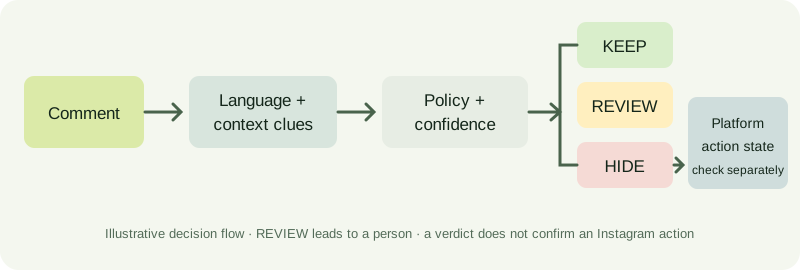
A human review routine
- Check the comment, parent reply, caption and relevant account history only as needed.
- Apply the written policy consistently. Record the reason without copying more personal information than necessary.
- Route unclear sarcasm, reclaimed language, slang or quoted abuse to REVIEW.
- If a threat or private information is involved, document safely, use Instagram reporting and seek appropriate support. Do not publish the evidence again.
- Confirm the platform action separately, then revisit mistaken hides and misses to improve the policy.
This routine is especially useful when several people moderate one account. It gives reviewers a reason to pause rather than guessing from a word or language label.
When not to hide a comment
Keeping legitimate conversation visible is part of moderation. Criticism of a product recommendation, a question about a creator’s claim, or a person quoting abuse to ask for help may contain uncomfortable words without violating a creator’s policy. Before hiding, check who is speaking to whom, whether the phrase is quoted, and whether the exchange is repeated targeting or ordinary disagreement. If that evidence is missing, REVIEW is safer than an automatic verdict. The human-control page explains this decision path.
English, Hinglish and Romanized comments
An Instagram reply may mix English and Hindi in one sentence, write Hindi in Roman letters, or vary the spelling of a slang term. A keyword rule can miss a variant or overreact to a harmless use. Language detection helps route a case but does not tell a reviewer whether it is abusive. The Hinglish Instagram moderation guide gives a practical process and links to the underlying research.
Reversing mistakes and checking action state
Sample both hidden and visible comments. If a harmless quotation, criticism or local expression was hidden, restore visibility through the platform when possible and record why the rule changed. If a harmful comment stayed visible, decide whether to hide it, report it or seek support under the policy. A decision log should distinguish the reviewer’s verdict, the action requested from Instagram, and the platform’s confirmed result. A failed or pending action must not be displayed as completed.
For an account that receives only a few comments, periodic manual review and Instagram’s own settings may be simpler than connecting another service. For a shared team, assign a reviewer for uncertain cases and a second person for appeals or high-risk incidents. The native-controls comparison walks through this choice without assuming SABHYA is always the answer.
Where SABHYA fits
SABHYA is designed to organize Instagram comment decisions around KEEP, REVIEW and HIDE, with explicit human review for uncertainty. It uses a human review workflow and complements Instagram’s own tools. The product does not replace platform reporting, emergency help, or the account owner’s judgment. Read how SABHYA works, privacy, and the system card for current limits before connecting an account.
Frequently asked questions
What is the difference between hiding and reporting a comment?
Hiding changes visibility in your conversation; reporting asks Instagram to assess a possible platform-rule violation. For threats or exposed personal information, reporting and a human escalation path may be necessary even if the comment is hidden.
Does a keyword filter catch all abusive comments?
No. Word lists are useful for known terms, but spelling variation, quoted words and context can change the result. Review both misses and accidental hides.
Should criticism be removed?
Not automatically. A creator can set boundaries, but good-faith disagreement should generally remain unless it crosses a stated policy line, such as targeted harassment or repeated abuse.
Can SABHYA moderate every Instagram account now?
SABHYA supports one Instagram Professional account per workspace. Request access to discuss whether the workflow fits your needs.
If your main problem is code-mixed comments, the Hinglish moderation guide explains why language routing is not a harm verdict. The native-controls comparison helps decide whether an assisted workflow is warranted. Request assisted access if that workflow matches your needs.